Interior Architecture
THE ENTRY HALLWAY
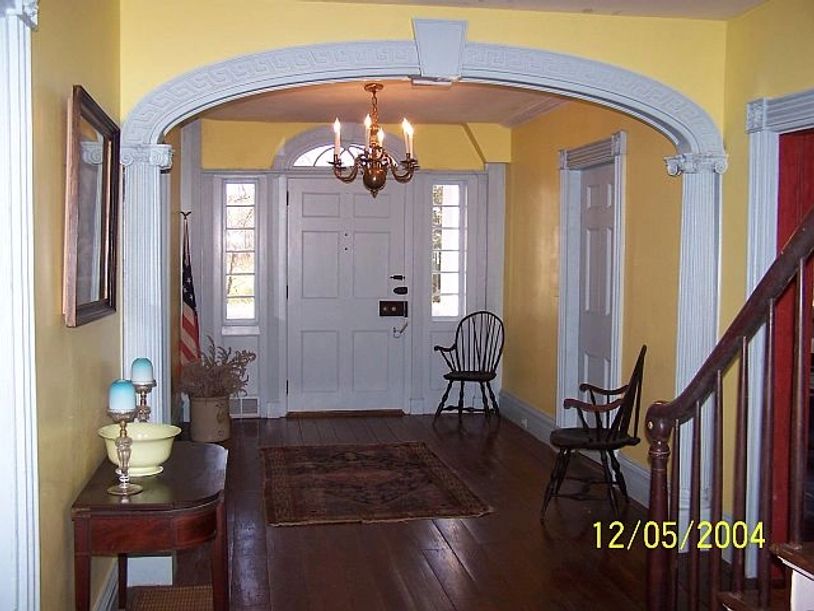
The focal point of the hallway is an elaborately carved classical arch, which divides the hallway into the front and back section. One side of the arch is decorated with the Greek key meander pattern, as shown in the above photo. This pattern is repeated on the moulding of the lunette-shaped window that tops the front door. The repetition of the design elements assure visual conformity where the arch, main door and side lights can be viewed, as seen in this photo above.
A moulded blocked keystone centers both sides of the arch and the window trim.
Interior paint colors throughout are derived from analysis based on houses of the same period.

As you enter the house, with your back to the main door, there is a variation on the decorative elements for added interest. The arch section facing you is decorated on the top with a stringcourse of egg and dart design and on the bottom with a stringcourse of bead design. The arch is supported on each side by engaged fluted wooden columns of the Ionic order footed on bases. The Ionic capitals repeat the egg and dart and bead decoration of the arch.
THE PARLOUR

The parlour is accessed from the center hallway front right door.
This room features the most elaborate woodwork in the house. The parlor mantel is especially elaborate and refined. Flanking the fireplace are arched alcove niches. The arches are supported by elaborate brackets decorated with rosettes, foliate motifs, scrolls, acanthus leaves and egg and dart. Moldings that are as rich as folded cloth define the arches. Their keystones have the masks of winged angels. There can be little doubt that the inspiration here was derived from Asher Benjamin or another Federal-era pattern book.
Parlour, North Wall
The windows in the parlour are framed by complex moldings in the Grecian taste with square architrave crossettes at the upper corners carved with rosettes. Base blocks are carved with rosettes in another pattern. The windows have low sills with paneled aprons.
DINING ROOM
The dining room is accessed from the center hallway front left door.
While the decoration of the parlour is Adamesque, the decoration of the dining room is ascending towards Greek Revival. Design elements in the parlour and the center hallway were incorporated in the dining room, such as the cut-corner motif, and the Ionic columns in the mantel. This suggests that the entire interior design of the house was integral and accomplished at the same time, making the house stylistically transitional Georgian to Federal
The wallpaper design is from Historic Deerfield. The design pattern is traced and highlighted with mica chips. Mica, used for its reflective qualities, is barely visible in daylight, though in candlelight the whole room flickers and glows. Mica can also be seen on the wallpaper at the Oliver Ellsworth Homestead at Windsor, CT.
The windows are framed by complex moldings in the Grecian taste with square architrave crossettes at the upper corners carved with bull’s-eyes, and the base blocks are incised with a cut-corner sinkage. The windows have low sills with paneled aprons. The elaborate trim at the doors show a variation of the door surrounds of the hallway and the parlour. There is a high moulded baseboard and a plaster crown ceiling cornice.
On either side of the fireplace are identical balancing doors. The left hand door, however, is a false door, put there for no other reason than symmetry. The right hand door accesses the kitchen. The floor is original pine.
THE KITCHEN

Is located at the southwest corner of the main block and is accessed through an unusual barrel- vaulted alcove off the entry hallway or by the dining room.
The focus of this room is a prominent fireplace with its original crane and beehive bake oven. The fireplace has a simple traditional moulded Connecticut-style surround and shelf. The firebox contains its original cast iron fire back, ash well and swinging iron crane. The bake oven has been reconstructed around 1990, and has proven successful. A schist hearthstone extending the length of the kitchen’s east wall is set out at the level of the pine floor
THE SITTING ROOM

The sitting room contains two doorways; one to the pantry off the main block and one to the entry hall. It is located at the northwest corner of the main block.
The sitting room’s east wall is its predominant elevation. The fireplace engages this wall between two full sized doors placed symmetrically for balance. The mantel shows an Adamesque transitional to Federal style. Above the mantel, set in to the wall, is a pair of deeply set vertical cupboards. Flanking the mantel are identical 6-panel balancing doors. They are used as cupboards.
The walls of the sitting room are decorated with white bas-relief stenciled cornice borders designed as “prunus blossoms on cracked ice”, a decorative device denoting the beginning of spring in the Chinese decorative arts. The decoration was taken from an English Wedgwood Baugh pot, circa 1815.
The dining room wool rug was made in England to an authentic 1810 pattern. An almost identical rug can be seen at Montpellier, James Madison’s home in Virginia.
MAIN STAIRCASE

SECOND FLOOR CENTER HALLWAY

Ascending the formal staircase to the second floor the front Palladian window comes into view. The exterior arrangement of the Palladian window is repeated on the interior. Fluted pilasters frame the tripartite window. The window trim incorporates crossettes incised with elliptical shapes.
For this formal area there is a high baseboard similar in style as the first floor center hall. The area of the Palladian window was a bathroom at one time with a wall that transversed the hall beyond the entrance to the right and left front chambers. The bathroom and its wall were removed. In place of the wall, an arch, patterned on one in the Pope Villa at Lexington, Kentucky, designed by Benjamin Latrobe, has been installed. Its style is Transitional to Federal and its design incorporates “pouch and gouge” scroll pattern in the curvature of the arch and raised fluted pilasters columns. The walls in the front hallway have been “Venetian” Plastered and waxed in a historically correct light blue color. The cornice is gray and the baseboard is faux painted to simulate dark blue marble.